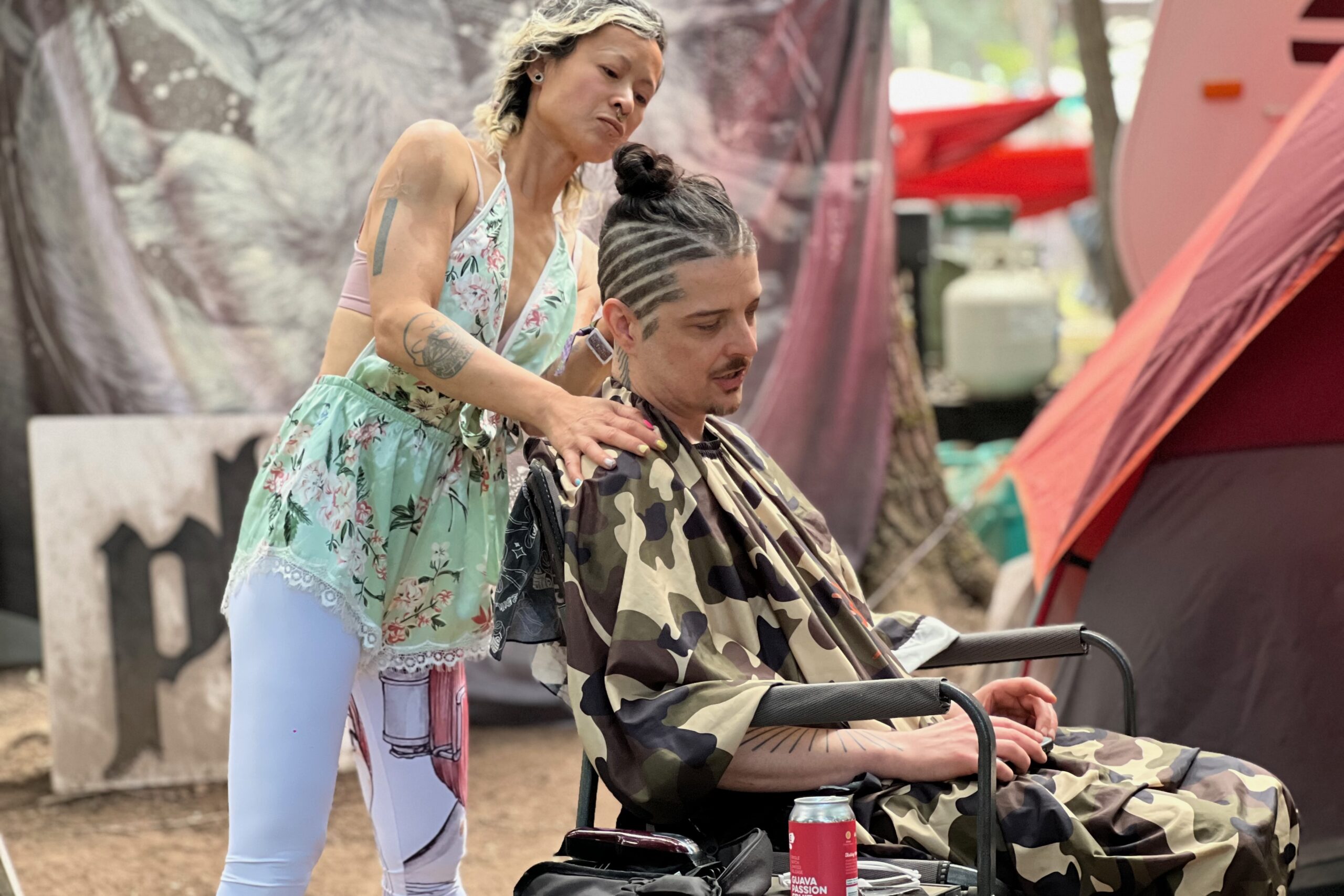
Behind a fleet of camping trailers in a small but dense patch of cedar trees, I meet Dylan Lane in front of his “house.”
The small and sturdy wooden shack, one of countless site modifications made to Salmo River Ranch for the annual arrival of Shambhala, isn’t a residence. But every July, when Canada’s premier electronic music festival returns to the 500-acre cattle farm near Salmo, British Columbia, it’s where he finds relief from the daytime heat.
He’s earned his little hideaway. The Toronto-born producer and DJ, better known as veteran experimental bass artist ill.Gates, has now played the festival 21 times.
“Who else has a house? Come on,” he jokes over the phone to a friend struggling to locate the hideout, as I had before.
Lane sits attentively in a camping chair as I step into his metaphorical dojo beneath the trees. He is one of several Canadian artists who have agreed to be my Shambhala guru for the weekend and fill in a first-time attendee on a quarter century of festival history at this year’s 25th edition, which returned from July 26-29.
“My festival journey basically started by accident, and because my buddy Dave had food allergies,” Lane recounts over the hum of a portable electric trimmer. His wife Nunich is giving him a haircut ahead of his first performance of the weekend.
Lane first attended Shambhala in 2003. Then a college student and breaks DJ performing under the name The Phat Conductor, he arrived on “The Farm” with nothing but a crate of vinyl and “just kind of crashed on the couch in the artist VIP,” hopeful to share his demos on Toronto labels like 2 Wars and A Revolution with that year’s headliners, like Adam Freeland and Freak Nasty.
Lane wasn’t on the lineup, but when his friend and headlining DJ Dave Dub experienced some “intestinal discomfort” during his two-hour set, Lane grabbed his records and filled in for Dave on the festival’s Fractal Forest stage. Mixing “battle-style,” he burned through an entire crate of records in just 30 minutes—though he says it felt like just 15—and has been invited back to perform officially at every edition since.
That first Shambhala experience was a turning point for Lane, whose career now encompasses decades of touring success, six studio albums, and collaborations with huge bass names like Excision, CloZee, Apashe, Pendulum‘s KJ Sawka, and many more.
“My first impression of this place was that I had been far too realistic in my dreams,” Lane says.
He’d played some of Toronto’s biggest commercial electronic music events of the pre-RAVE Act 1990s, like WEMF, which in its “early days” attracted at least 50,000 people by his estimate, “but it wasn’t like this. It wasn’t as musically interesting,” he says.
Instead, at Shambhala, Lane found new career affirmation in a music nexus where his style of bass music was celebrated authentically, and glimpsed a newly bright future for the whole of underground electronic music in its stead.
“Coming to a place like this as a musician was really incredible, because it was a vision of possibility and the realization of that possibility, and even back then, it was already so far beyond other festivals,” Lane says. “This place is where I come to have my faith in humanity restored, because that was the vibe that I got when I came here in the early years. This is a reason to have faith that big underground things are possible.’”
What began as a small one-stage rave on founder Jimmy Bundschuh’s family farm in 1998 has grown to host hundreds of acts across six stages and attracts close to 20,000 annual attendees, drawn to its remote location on the banks of the glacier-fed Salmo River by top musical talent, astounding production, pioneering harm reduction efforts, and remarkably holistic vibes.
All the while, Shambhala has stayed true to the underground spirit Lane fell in love with two decades ago. It remains family-owned and operated, held on private land without corporate sponsorship, standing out in a live music landscape dominated by Live Nation, AEG, and the like.
As Lane points out, “a big commercial music festival with inflatable Budweiser cans is a very different experience from something like Shambhala.” Renegade down to the bones, each stage is independently designed, booked, and operated, and continues to spotlight electronic music’s lesser-known genre corners.
For example, this year, UK-centric 140-BPM dubstep—a now-resurging genre Lane says he used to listen to with just ten friends at an empty Jamaican bar in Toronto—anchored one of the AMP’s most social media buzzed-about Saturday night lineups yet, featuring sets from Eprom, G Jones, PEEKABOO, Truth, Ternion Sound, MYTHM, Veil, Zen Selekta, and more.
Though he doesn’t have the full Shambhala “Thanos gauntlet” (Mat the Alien is the only artist with that accolade), Lane has played on four of the festival’s current stages, five if you count the late Muscle Beach stage.
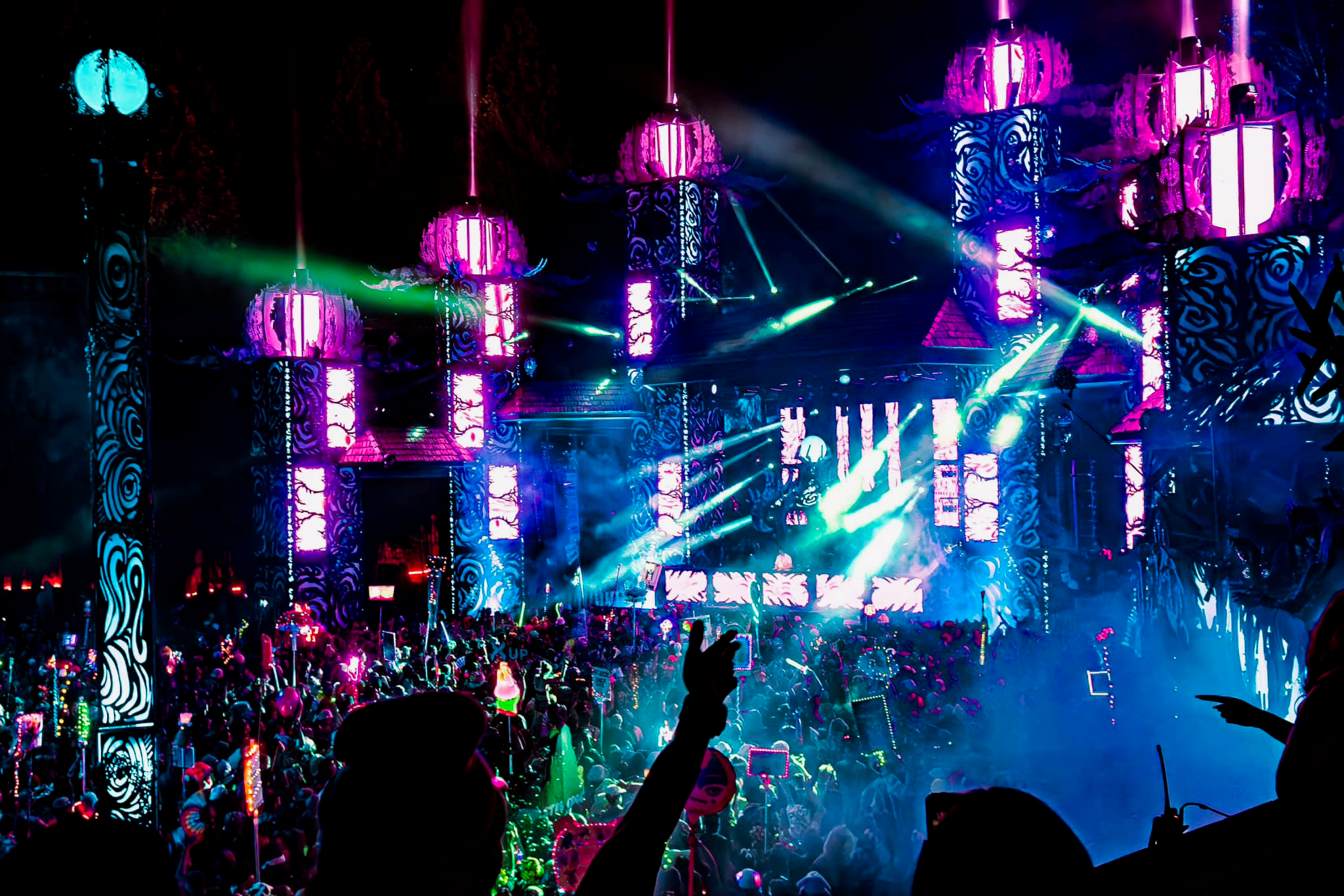
But chief among them, and perhaps the most emblematic of Shambhala’s underground triumph, is the Village. Bass music has long been an important part of the festival’s musical melting pot, and the genre-specific stage pays homage with a truly glorious audiovisual experience.
Featuring treehouse walkways with intricately carved psychedelic patterns and towering gothic-looking spires, the Village, which Lane calls “a church of bass,” is outfitted with one of the most technologically advanced sound systems on Earth. After all, it’s the unofficial birthplace of PK Sound, one of the live music industry’s leading loudspeaker manufacturers and custom sound system operators.
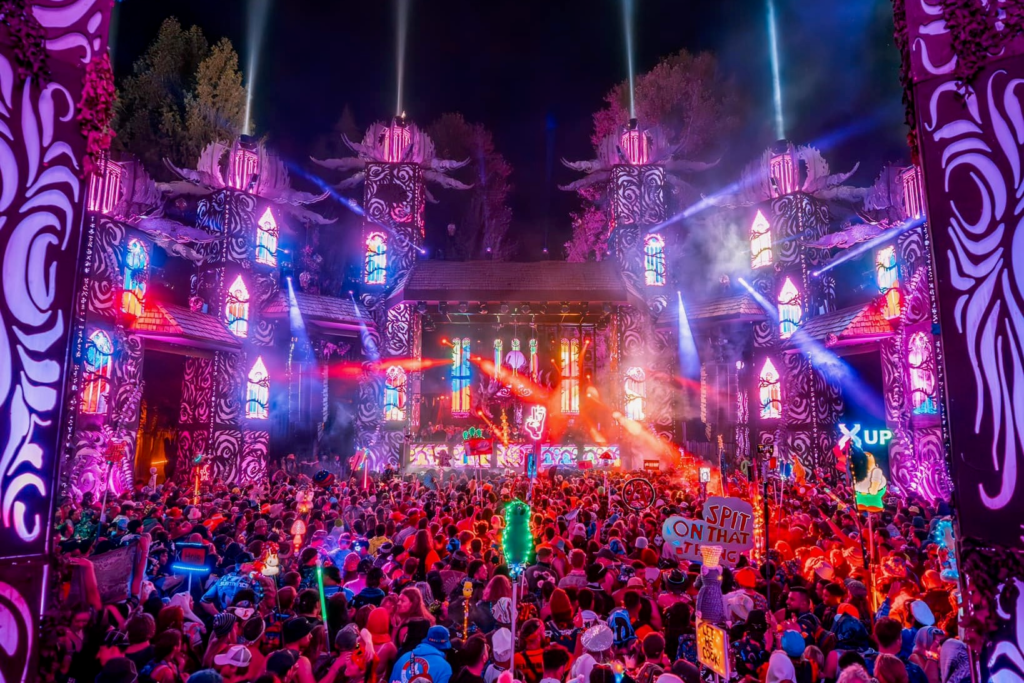
Village stage directors Jeremy Bridge and Eroca Colins are also the Calgary-based company’s founders, and every year, they outfit the stage with their latest and greatest robotic line-array system.
“You think that eventually you’d get used to it. But no, every single time you play on that stage, you feel like your entire life has led up to that moment,” Lane says. “And it never, ever gets old.”
“Every year there is the future,” he continues. “Every year, they’re testing, they’re growing, they’re optimizing. There’s new things that they’re trying. This is the space that in their minds, when they’re designing everything, they’re like, ‘How is it going to sound in the Village?”
Shambhala’s underground triumph is also reflected in its commitment to the local Canadian artists who have been instrumental to its success.
Comprising most of its bookings, they shine at the festival, and many leave their mark with curated programming, like ill.Gates’ own “The Chillage,” a self-described “wublic service” that brought late-night downtempo bass sets and B2Bs from ill.Gates, Mr. Bill, shmani, and slowform to the Village stage on Saturday, and Calgary house duo Smalltown DJs’ all-vinyl “Fractal Funk Jam.”
Each year, the five-hour Sunday afternoon jam sesh invites Canadian artists of all sounds to step up in the Fractal Forest and mix their favorite old-school funk records. One by one, each artist gets their moment to shine, and from my place in the crowd, it felt as if the whole of the Western Canadian festival scene was performing as one act.
Among them this year was Joanna Magik, who recalls those day four vibes throughout her 16 years of attending Shambhala: “By Sunday, everyone’s just kind of equal. You don’t know what someone does for a living. You don’t know what their sneakers are because they’re covered in mud or dirt. So you’re just all together, and I think it creates a big release.”
The Calgary-based DJ and producer—born Joanna Majcherkiewicz—played her third consecutive solo set in the Fractal Forest this year but has been coming to Shambhala since 2007. Clearly passionate about the festival, she’s even prepared notes for our happy-hour chat in Shambhala’s woodland artist lounge.
In those notes are nearly a dozen names of the legendary Shambhala DJs who Magik says were a huge part of her early festival journey: Skratch Bastid, Smalltown DJs, Mat the Alien, the Funk Hunters, Vinyl Richie, Foxy Moron, Justin Martin, and more.
“Z-Trip, and seeing the Village feeling like Mad Max and him killing it, smashing it, it just gives you life,” she says, adding another to the list.
Magik now calls many of these Shambhala legends friends and points out that while Canada is geographically massive, the country has a smaller population than California, meaning its festival scene is inherently “close-knit,” and most artists know each other.
“It’s sweet, because I focus on house music and dipping into techno, but they focus on funk or drum & bass, dubstep,” she says. “We’re all friends because we all see each other in the same spots, and it’s really cool to see everyone support each other.”
Danny Fernandez has felt the strength and support of that close-knit scene personally. Not only did he find a new community in Shambhala, but Shambhala helped him find a new community in electronic music.
Better known as Def3, the Vancouver-based MC, DJ, and producer had little prior knowledge of electronic music when he rapped at an underground hip-hop showcase in exchange for a festival ticket in 2010. Now, he’s a Shambhala resident, performing at every edition since 2012 and hosting the AMP’s Thursday festivities since 2014.
At the start of his Shambhala journey, Fernandez says he was going through an “identity crisis of what I wanted to be as a rapper.” Breaking through in the Western Canadian underground hip-hop scene by the early 2000s, he had come up in an era of traditional-media-driven rap promo, when crews made their names in monthly and weekly showcases and cyphers.
“The hip-hop scene that I fell in love with didn’t really exist as much anymore,” Fernandez says. “And so in a way, I was kind of lost. I felt like everything that I loved about hip-hop changed so much, and the new sound and direction of it, I didn’t feel like it was going to be me.”
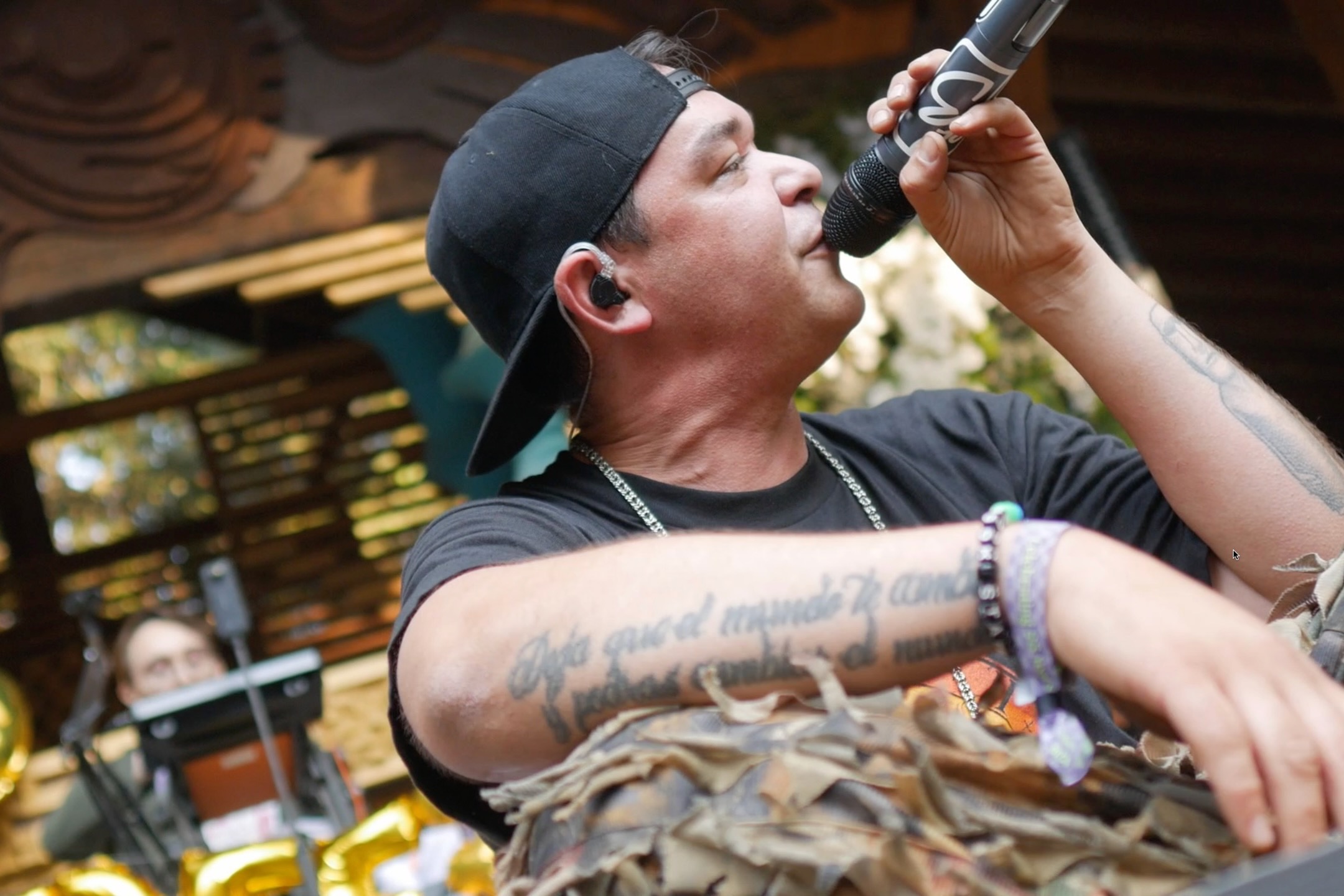
But after his timely discovery of electronic music at Shambhala, Fernandez says, “A lot of the stuff that I felt like I lost from the hip-hop community, I found in the electronic community.”
Spurred by the boundless possibility of electronic music production and then-trending hip-hop-aligned electronic genres like Trap and Moombahton, Fernandez is now carving out a new space in the electronic realm with releases that merge the freestyle bars and boom bap hip-hop of his youth with the bass-heavy beats he discovered on The Farm.
All the while, Shambhala has remained a creative catalyst and collaborative cornucopia for Fernandez’s electronic revival. It’s where he met Whistler-based house duo and fellow festival legends SkiiTour, which would lead to their 2016 collaborative single, “The Original,” Fernandez’s first in electronic music.
More recently, it’s spawned collaborations with Dr. Fresch and Mr. Bill, an impromptu performance with Mr. Carmack, and provided Fernandez with a network of artists breaking similar hip-hop-electronic-fusion ground, including longtime friends and collaborators like Pigeon Hole, ill.Gates, K+Lab, and Pav4n of Foreign Beggars.
“That was the beauty of doing the host thing. Things like that always happen, and you can connect with people that way, on a cool level where you’re like, we didn’t know each other at all, but we shared this cool moment together, and that’s happened to me with so many different artists here over the years.”
“I think as a community, it definitely has its own ecosystem, and it can be a catalyst for a lot of artists, specifically, if you can find your niche, or maybe it connects you with the people,” Fernandez says of Shambhala.
“For my own journey, that’s what I’ve seen grow the most, because I see the steps that people are taking, even outside of just being artists, whether it’s media, or within HR kind of jobs, if you’re hungry and want to learn something, there’s an opportunity there for everyone,” he continues.
Featured image courtesy: Shambhala. Credit: Bryan Dellosa.