
One might be forgiven for assuming Hans Glader is British.
“It’s either ‘I thought you were British’ or ‘I thought you were German.’ ‘I thought you were Swedish,’” the California-based producer, DJ, and drummer tells EDM Maniac over video chat from his studio. “If I kept my mouth shut, maybe I could roll off as an Australian or something.”
Though he makes his steppy, shuffled beats from his home in sunny Glendale, Glader sits firmly among the biggest, and mostly British, names of UK garage’s recent global resurgence.
Over the last five years, in North America and other regions slower to embrace the distinctly British electronic subgenre—defined by its syncopated rhythms, rolling basslines and R&B stylings that dominated the UK club scene and radio airwaves (illegal and sanctioned) in the 1990s—UK garage has gained wider notoriety and commercial appeal. While it’s always had a stronghold in Britain, next-gen exports like Sammy Virji, Interplanetary Criminal, MPH, and Oppidan have reintroduced the bassy house music variant to larger global audiences through a modern lens. From corporate ad spots to video game soundtracks, viral social media attention, and a growing share of Stateside bookings, it’s a genre revival that’s been dubbed “NUKG” by music journalists on both sides of the pond.
Glader fell in love with UKG’s trademark swing long before it was headlining American festivals. Disillusioned with the bass house he was making in college, the San Francisco-born artist and trained jazz drummer pivoted to producing his favorite sound full-stop in 2019. He sent his first tune to Virji, then a rising DJ and producer who had just graduated from university in Newcastle.
Hooked by the authenticity he felt in bringing his live jazz drumming to UKG’s skippy rhythms, Glader spent years entrenching himself in what was then still a fairly intimate and niche UK garage scene (even in England), sharing music, collaborating, and forging international friendships with Virji and more of the artists who have become the biggest of the genre’s second act: Oppidan, MPH, Conducta, even genre legend DJ Q. After all, UK garage is a product of transatlantic exchange: the sound as we know it developed when British DJs began playing American house records at faster tempos.
Now, like that of his British colleagues, the noise Hans was making abroad is resonating deeper than ever at home in the U.S., where his oft-quoted “jazzier, funkier, Californian UKG,” fits right in “with the rest of the crew,” Glader says. “I think really the only difference between us is that I’ve lived here, and they’ve lived in the UK.”
Two stops into his first proper headline club tour of North America, and a week removed from the release of “La Belle,” his new Casablanca-sampling collaboration on Virji’s surprise album, Open Late, Glader spoke with EDM Maniac about his place in UK garage in the exclusive interview below. The artist’s fall tour rolls on to Reno and San Francisco this weekend ahead of “Caravan,” another fan-favorite, sample-heavy tune that’s finally been cleared for official release on December 4.
EDM Maniac: Congrats on the latest release. You and Sammy go way back as friends and colleagues. What does it mean to you to have that track land on his album, and how did it come together?
Glader: That was a little bit of a surprise for me as well, because he kind of just reached out to me in the midst of touring. He’s like, “Hey, I’m gonna do this surprise album.” I don’t think even some of his closer mates knew. I’m acquaintances with Will [Cunning MC] and Yemi and those guys, and to think that they didn’t even know this was coming out, I was like, “This is going to be a shocker for the public, but also for everyone else.”
We’d obviously worked together, but that was COVID up until probably 2024, all on the computer, all virtually, and I hadn’t been in a studio session with really anybody in LA. At that point I was doing stuff in my apartment. I was like, “There’s no way I can get people in this room and make tunes and take myself seriously.” Next thing I know, Sammy’s like, “Hey, I’m going to be in Pasadena in a couple days. You want to make some music?” And I was like, “You know what? Screw it, let’s do it,” and we made a couple tunes.
It just felt right to be there and do it together, so we didn’t really ask any questions. We went out to breakfast before that, and we’re listening to movie soundtracks, and I think that’s where the idea for Casablanca came. When we left that session, it was interesting because we had two songs actually. I don’t think there was ever a thought about releasing the one [“La Belle”], just because of the logistics of clearing it. I think to get that song out is fantastic. Sammy and I have been working on music for a long time, so to release the one song that we made together in person is pretty cool because I think we could have just as easily turned around and done something else.
EDM Maniac: What stands out to you most about the process in the studio?
Glader: I’m trying to put myself back in Pasadena when we did it, because I was not ready to have a studio set. I like to think I’m really prepared for these sessions and come in with music, and all I had was drums. I was like, “You know what? This is what I’m good at. This is what I think I can do naturally.” So I just gave them to him. He’s like, “Alright, we can work with these.”
It was a good way for me to discover what I’m good at in the studio. I think that’s also something that I’ve struggled with for a while, understanding where your lane is as a producer, and understanding what you’re good at. If you’re collaborating and you’re in the studio, to take advantage of those angles that you have. I’ve been a drummer my whole life, and I grew up playing drums, so the rhythm and syncopation of music is what stands out to me. It made me realize that these drums were definitely the direction for my production.
It took such a long time to finally finish that tune. There’s all these tangible changes, and the perfectionists in both of us I think is what took it so long to kind of get where it is. But it’s really good. I’m really happy.
EDM Maniac: Sammy is one of the biggest names of this wave of UKG, and you’ve been a Stateside steward of the sound for a while. How did you first get connected, and what has that relationship meant to your journey?
Glader: Sammy was the first person I reached out to when I started making this music. I was making bass house music in 2018. I left school and was on a study abroad program, and ended up not doing the program because I was not part of the school anymore. But I was still in Paris and was making a bunch of music and meeting some people, and ended up making some tunes and releasing a song under a different alias that was much heavier.
On that trip, I’d made this decision to change my alias to my government name, start making music that was a bit more of what I grew up listening to and grew up playing. As soon as I do that, I made a Jorja Smith remix and just started sending it to anyone who I thought would play it, and at the time, Sammy was blowing up. He’d just come out of university in the UK and was figuring out his life. And he replied to me, “Dude, this is sick.” I remember seeing that when I turned my phone off airplane mode, getting back to the States. I was like, “Mom, you don’t know who this guy is, but this is the coolest thing ever.” He ended up getting me on his Rinse FM residency he had at the time.
This guy understands what I want to do, understands this type of music, and for him to support at that early stage was incredible. So fast-forward to now, it’s a big full-circle moment. I felt like he kind of leaned down, gave me a helping hand when I was a young aspiring American producer. It’s been almost an eight-year process of fully meeting this guy. We’ve linked up and had some sessions here and there, but he was genuinely the first person to share my music, and at that point, the only music I had was what I had just come from college with. I feel like anyone could have realistically been like, “Nah man, this is shit.” But either he heard something that other people didn’t, or he was just being nice. Whatever it is, it did a lot for me.
EDM Maniac: “La Belle” isn’t the first time you’ve released together. You and Sammy teamed up on “Be Careful” in 2020. What’s changed from then to now?
Glader: The States I don’t think had very much introduction to UKG in any sense other than house music and its variants. At the time, we did these radio things, and very quickly thereafter, we had his first album come out. He’s like, “You want to do a song for this?” I’d already sent him this idea, and we very quickly made that [“Be Careful”].
At the time, it did nothing for me and my American fans, because that name didn’t really register on most of my friends, my family, listeners. For me, it was just a big booster. There was a lot of push that I could do on my end, being like, “Oh, I’m this new American.” I feel like I’m one of the only Americans at this time who was holding it down with this UKG sound, kind of speaking into a wall, because I didn’t know necessarily if anyone was listening. I’m talking about such a niche genre in a different part of the world that hasn’t really caught up yet.
It was just continuing to do that for months and months and months, growing into a year, two years, and before you know it, it’s Zara ads, Dua Lipa songs, video game commercials, UKG, UKG, UKG. You could see it coming to the States. You could see it wiggling its way into these corporate things. You hear it at a business event. The Brewers just won the World Series, they’re spraying champagne and they’re listening to “The Days” by NOTION in the locker room. How random is that? You’d never have that.
Seeing that whole process of it coming over and then eventually the name recognition, the name dropping of Sammy, Oppidan, and MPH, all of a sudden people know who these people are and kind of salivate over them, and that did great things for me. At that point, I’m no longer an artist that’s trying to bandwagon, hop on this UKG train. I can turn around and show this existing discography of music for myself, but also collaborations with these guys.
EDM Maniac: What does it mean to you to be in this class of artists pushing the sound in the U.S. and globally right now?
Glader: It having such massive success in the last few years here, I think that’s mostly the responsibility of Sammy and MPH and Izzy [Oppidan]. Those guys do a lot of touring, but they come into town, they play their music, and they leave. What’s there when they’re gone? I’d like to think that I continue to hold it down, continue to not make adequate music, but make really good music, and make music that could easily fit in with the rest of the crew. I think really the only difference between us is that I’ve lived here, and they’ve lived in the UK.
The hilarity of show offers and festival offers, or just, “Hey, you want to meet up for a pint?” is I have to break these guys’ hearts. “I live in California and you’re probably gonna laugh when you hear me talk.” It’s either “I thought you were British” or “I thought you were German.” “I thought you were Swedish.” To the naked eye, I’m just another UKG producer. If I kept my mouth shut, maybe I could roll off as an Australian or something.
I think people seeing Sammy and I work together definitely is boosting the credibility of the genre. Obviously, him working with me does more for me than it does for him, but I think it does a ton for the American audience. If you’re a fan of electronic music, and now have dipped your toes in this UKG, stumbled across it on your Spotify page, or don’t know what it is but are now seeing another American artist working with a predominantly UKG, British artist, I think it’s great to get everyone involved and not have this historical UK-American standoff that still exists.
We go way back, Sammy and Izzy both. The two of them, I consider them close friends, and we get along first and foremost before music. I think that does something really special for when we do get together and make music, because it feels less like a job, less like a process and a duty of, “Oh, we have to make something because everyone’s expecting it.” In reality, it’s just like, “This is great. It’s good to see you and good to hang out.” I really wouldn’t have it any other way. It’s the perfect little niche, and I feel like I found it at the right time. Obviously, they started blowing up, and I started blowing up, and I feel like we’re all coming back together and finding our best way to make music.
EDM Maniac: You’re two dates into your fall headline tour, a proper club run with a revamped show, new music, and new analog, VHS-style visuals, all of which you’re building yourself. What inspired the visual direction of the show?
Glader: I assume a ton of kids had a parent with a camcorder, and you’re just playing around with it. Then years later, you’re going through this, and you’re watching all these tapes, and it’s just so cool. You’re watching something and it gets interrupted, and then there’s my face as a seven-year-old, and then it turns off really quickly. I think I just came to absolutely love that feeling of organized, analog chaos.
The visuals of this kind of distorted VHS camera, computer, TV glitch stuff, the nature of glitches, they’re not symmetrical, they’re not perfect. In the very same breath, I love people like Wes Anderson and cinematography and filmmaking and symmetry. So I think putting the two of those together, having these really nice, not always symmetrical but beautiful compositions with this pinpoint of insanity, chaos, and visual stimulation going on, that kind of contrast between those two, I found really interesting. I’ve been making visuals for a long, long time, and making all these videos and teasers and promotional videos for songs, and I just find myself wiggling in this analog stuff throughout all of my videos. I just realized, “I’ve been doing this. Why don’t I just start to make visuals that are all about this?”
Like two months ago, I just had a massive yearning to make some tour visuals, so I just sat down, looked at this folder of like 200 videos, and I was like, “Alright, what is something that lives amongst all these videos?” And that was the OSD analog VHS. That’s kind of when I realized, “Of course it is.” That’s the first thing that makes you think of your childhood. Makes you think of your mom. Makes you think of early music. Filming yourself drumming.
The visuals, and specifically for the live show, it’s kind of all about that. That digital-to-analog world, but leaning more heavily on the analog side of things, just because that’s where I come from, and grew up as a kid in that time where that was all that we had.
EDM Maniac: Do you also find yourself returning to old music ideas for inspiration?
Glader: It’s the same with music projects, and that’s been a huge part of my brand. I just don’t give up on anything. There’s a lot of stuff that I think people either don’t give themselves credit for or listen to too much and just kind of throw away.
I’d like to think that 85% of all the music I put out is stuff that is probably a year or two old, that I’ve just kind of been revisiting years after, and all of a sudden got this massive amount of motivation. I have this big bag of stuff that I’m working on, and I kind of reach into the bag and I don’t know what I’m gonna pull out, but whatever I pull out is probably gonna make me excited.
I’m starting to realize with the video work as well, there’s so much good stuff here that sometimes you just need to leave it alone and let the ideas simmer a little bit.
EDM Maniac: Beyond visuals, what does it mean to you to get to curate support and musically build a proper headline show like this?
Glader: It’s massive for me. I’ve been doing a lot of the support stuff, which has been really good. I think it’s great for me to understand and realize how to DJ and how to put on a good show. For one reason or another, it’s amazing to be able to test out those things in front of Sammy’s audience if you’re supporting him. I can’t say I would have had the same success playing out some of my original music if I was a headline act in 2021, when I’m playing to a room of 15 people, versus direct support for Sammy. I can get those reactions, and a lot of people are here to see him, but it’s like, “This is what your music does to people in a room,” and it’s nice to know that even if some of them didn’t know who I was.
Getting to drive the ship has been really cool. I love being able to tweak as many different things as possible. It’s so cool to get support on. I’ve met so many cool people, especially from San Francisco and Denver, all these guys, and played with them in all these different parts of the country, whatever realm that was, if it was an après ski show in Denver or the local support before Sammy. It’s actually been quite liberating and feels really good to hit up some of these people and start curating a supporting lineup, the visuals, and then, most importantly, the set, which I’ve been having so much fun with lately.
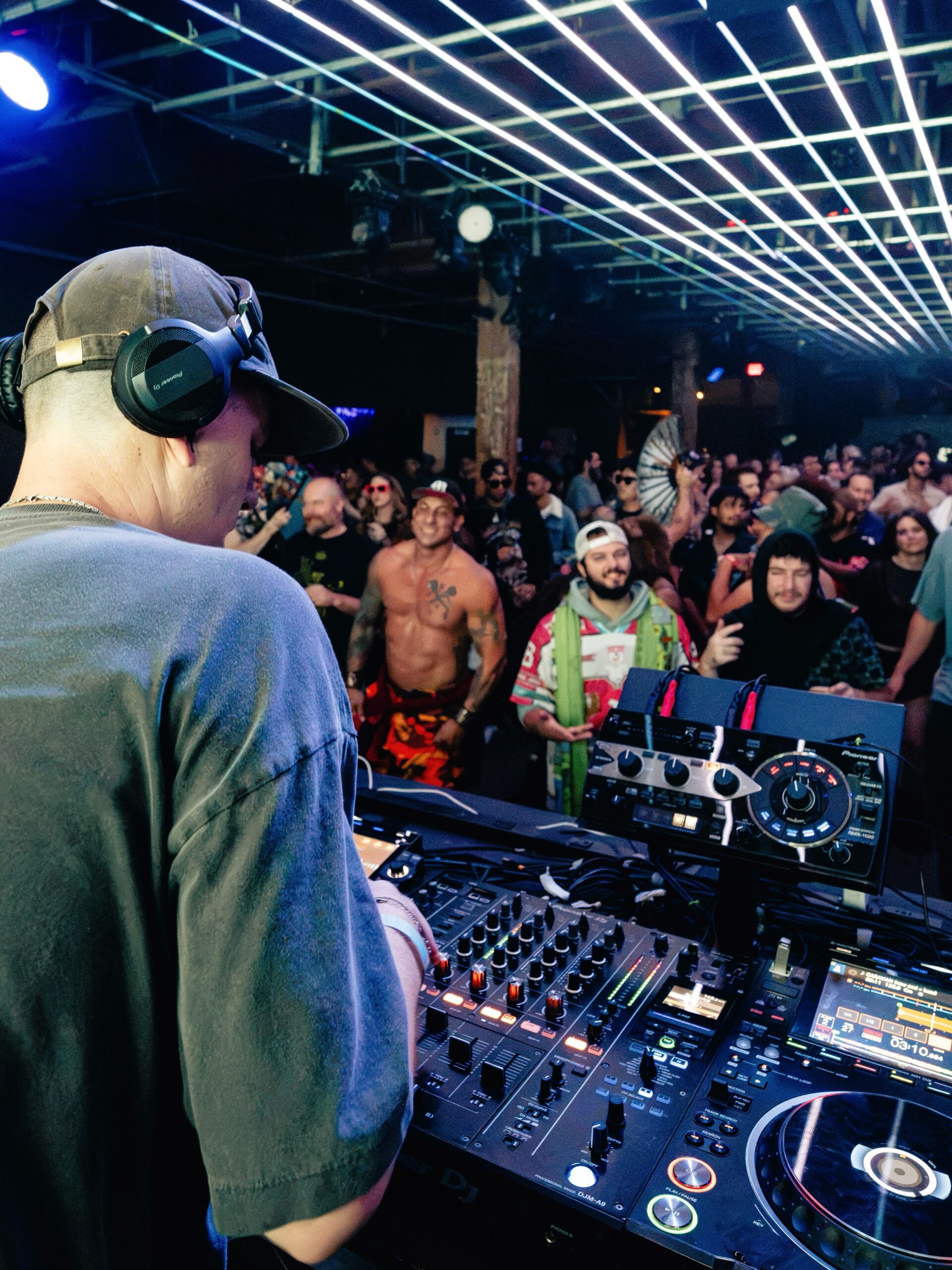
EDM Maniac: What is your process like for refining the set?
Glader: I go into a show, and I think I’ve got some good idea of where these songs are, I think most of them are mixed and mastered good, and I think I’ve got some good ideas for a transition. I get done with the show, and I’m like, “Ah, man, I need to change this, and I need to go back and tweak all this stuff.” I end up doing all this new work and make new music by the next show, and you do that whole process again. Then you go ahead, and it comes back, and it’s the same. “I’ve got to tweak this,” and you’re slowly getting closer to understanding the type of show you want to put on.
I want to be able to get to a point where I can play an hour and a half of music that I, as a DJ, am genuinely excited to play. And I know that sounds non-intuitive and dumb. I love DJing. I love playing every song, I do. But there’s some songs that I play where I just look down and I’m like, “Yes, man.” It’s either something that I was just working on, and a lot of the time it is that it’s a more recent kind of iteration of a song I’m working on, or a brand new song. I’ve always thought about that. I want that feeling.
EDM Maniac: How have the first tour shows been so far?
Glader: It’s the closest it’s ever been to that constant DJ euphoria of me just really happy with the music I’m playing. I think it’s a mixture of the people who know me for who I am can get their taste of my music, and then all this new stuff that no one knows is me yet, but just continuing that Hans Glader sound. There’s no headliner to accidentally outdo or take the energy away from. So to have that ability, but also that responsibility, you need to put on a really good show. I need to put on a proper show that makes sense and can flow the same way a song does. I’d like to think the sets are like that.
I don’t want you to ever feel like, “Oh, that didn’t sound good” or “that was a little bit out of key,” so I think a big thing is that most, if not every single one, of my mixes harmonically sound in key. From a musical background, I literally get off on that shit, harmonizing some chord loop with another vocal that I’m bringing in, figuring out what is a new way to do that, and that’s what DJing is all about for me. Figuring out the responsibility of how to do that, but also to put on a show that feels like this hour-and-a-half-long journey.
And I know that sounds so corny, but I think there’s so many loopable elements of UKG, specifically my music and UKG. It makes it so much more fun for me to mix when I can do that style of looping and crafting live, and it gives me so much satisfaction. I think it helps make the show that much better, because I look that much happier. I look like I’m actually enjoying. Not that I’m not, but I genuinely am having the time of my life when these mixes sound good. So I think to get close to an hour and a half of just pure bliss like that, it’s gonna be fun.
The biggest thing is the responsibility. It’s exciting, it’s sick, but something I’ve never really thought about doing these support shows. There’s always that headliner that can kind of take it home and seal the deal. And now, as a headliner and curating these shows, and especially a genre that’s as niche as it is, it’s a duty to do the genre right, but also make it flow properly, make it a genuine dance set, and not just a compilation of music.
EDM Maniac: Live improvisation like that is a big part of jazz drumming. Will we ever see a Hans Glader live set?
Glader: UKG is so drum-heavy, and I think a lot, if not all, of my music is primarily based in, “OK, how can this be played live?” Then, “Is there any way to embellish it and make a song out of it?” And then that’s the song you end up hearing. I’d like to think at some point in my life there’ll be a time when I can go back to college and find my boys, get our quartet back together and perform all of this music in its raw form, its intended form. The majority of this music could probably be played with drums, a bass guitar, piano, and then some sort of horn, and that’s kind of what I was dealing with in New Orleans.
It’s just having other aspects of it to push it into this UKG electronic music world, but knowing that when you boil it down, it all stems down to this really authentic, raw jazz music, so that’s a whole other side of what I want to explore in due time. But I definitely want to make sure the time is right for that because I don’t want to be rushing into those projects when I’ve been thinking about it my whole life. I love drumming, and the only reason I make UKG is because I have been drumming my whole life. And if there’s a way to tie that all back into a live set, it’s just sourcing drum sets and figuring out a way to bring five carry-ons.
The irony is I did that my whole life, literally traveling in my car with drums, like to the brim, when I was in high school, playing every weekend at these places, hours away. Now I’m like, “Holy shit, all I have to bring is a USB.”
When the time comes, it’s gonna be sick.
Featured image courtesy: Hans Glader.